Model
Every shape so far has been typed in by hand: a triangle, a rectangle, a cube of 36 vertices. That is fine for a cube, and hopeless for anything an artist would make. Characters, buildings and props are built in modelling tools such as Blender, Maya or 3ds Max, where the artist shapes the mesh, unwraps it onto texture images (
There are a great many model formats. Some are tiny and only describe geometry with a few material hints; others, like Collada or glTF, can carry whole scenes with cameras, lights, skeletons and animation. LearnOpenGL handles the variety by using Mesh class and a Model class that walk that tree.
We do something smaller. Our models are all in one format, the Wavefront .obj, which is plain text and simple enough to read ourselves, even in assembly. The reader lives in includes/learn/model.rasm, about six hundred lines with their comments and no library behind it, not even the C library's functions to turn text into numbers, and it covers in one place what Assimp, the Mesh class and the Model class cover in LearnOpenGL. This chapter walks through it, and then loads a backpack.
The Wavefront .obj format
An .obj file is a list of lines, each starting with a short keyword that says what the rest of the line is. Here are a few lines of the backpack we will load, one or two of each kind we care about:
mtllib backpack.mtl
o Cube.028__0
v -0.556751 -0.023763 -0.141540
v -0.556645 0.003057 -0.140628
vt 0.283512 0.401314
vn 0.0001 0.9989 0.0473
f 55/1/1 57/2/2 58/3/2vis a position, three floats.vtis a texture coordinate, u and v.vnis a normal.fis a face. Each corner is writtena/b/c: the index of its position, of its texture coordinate and of its normal, counting from 1 in the order the lines appeared. Parts may be missing (a//c,a/b, or a barea), and a face may have more than three corners.mtllibnames amaterial library , a second text file (.mtl) next to the model that describes its materials.
Other keywords exist (o and g name objects and groups, usemtl switches material, s sets smoothing groups), and our reader skips every line it does not recognise. The material file is in the same style. The backpack's has one material, and the lines we read are the ones that name texture images:
newmtl Scene_-_Root
Kd 0.800000 0.800000 0.800000
map_Kd diffuse.jpg
map_Bump normal.png
map_Ks specular.jpg
map_Kd is the diffuse texture, map_Ks the specular map and map_Bump a normal map, which we will need in Normal Mapping. These are exactly the diffuse and specular maps from Lighting maps, so the lighting we already have will work on the model unchanged.
One feature of the format shapes the whole reader. A face indexes positions, texture coordinates and normals separately: corner 55/1/1 takes position 55, uv 1 and normal 1, and the next face may pair position 55 with a different uv. A GPU vertex is not like that. The input assembler reads one vertex as one record, with its position, normal and uv side by side, all fetched with the same index. So whatever the file says, every distinct corner has to become a complete vertex of its own.
A vertex, and a model
LearnOpenGL's Mesh chapter starts by defining what one vertex is. Ours is the same three attributes, in a struct:
model_vertex: struct = {
    position: vec3
    normal: vec3
    uv: vec2
}
#define MODEL_LAYOUT_COUNT 3
model_layout: [MODEL_LAYOUT_COUNT]const D3D11_INPUT_ELEMENT_DESC = {
{ .SemanticName = "POSITION", .Format = DXGI_FORMAT.DXGI_FORMAT_R32G32B32_FLOAT, .AlignedByteOffset = 0 },
{ .SemanticName = "NORMAL", .Format = DXGI_FORMAT.DXGI_FORMAT_R32G32B32_FLOAT, .AlignedByteOffset = 12 },
{ .SemanticName = "TEXCOORD", .Format = DXGI_FORMAT.DXGI_FORMAT_R32G32_FLOAT, .AlignedByteOffset = 24 },
}
A struct's fields sit in memory one after another, in the order they are declared, so an array of model_vertex is exactly the interleaved stream of floats a vertex buffer wants: 3 + 3 + 2 floats, 32 bytes per vertex. It is the same layout as the cube's in Colors. The input layout beside it says where each attribute starts inside that record. LearnOpenGL computes those offsets with C's offsetof; here they are written out, 0, 12 and 24 bytes, and the stride of 32 comes from sizeof(model_vertex) when drawing. Because the layout ships with the loader, any shader that reads POSITION, NORMAL and TEXCOORD can draw any model.
What the loader hands back is just as small:
model: struct = {
    vertices: *ID3D11Buffer                ; of model_vertex
    vertex_count: u32
    pad: u32
    diffuse: *ID3D11ShaderResourceView     ; map_Kd
    specular: *ID3D11ShaderResourceView    ; map_Ks
    normal: *ID3D11ShaderResourceView      ; map_Bump
}
One vertex buffer and up to three textures. (A rasm struct is laid out as C lays it out, so C would leave those four bytes after the count by itself, to keep the three pointers on 8-byte boundaries; the pad only puts the gap on the page. The members are typed, so the debugger shows diffuse as a view, not a number.) LearnOpenGL's Model holds a list of Meshes, each with its own buffers and its own list of textures, because Assimp hands models over as many meshes. Every model in these lessons uses a single material, so one buffer and one set of textures describes the whole thing, and drawing it is one draw call. A loader for bigger scenes would split the vertices by usemtl into several such ranges, one per material; we come back to that in the exercises.
Reading the file
rcx and comes back, moved, in rax. They are leaves, procs that call nothing, so they have no frame at all: no pushes, no sub rsp, just the instructions and a ret. Skipping spaces and tabs is the simplest of them:
; rcx is the cursor going in, rax the cursor coming out. These are leaves of
; this file that touch neither the stack nor aligned memory, so the procs
; below call them without lining rsp up first.

; rcx: cursor -> rax: past spaces and tabs (touching only rax and r9: callers
; keep pointers in rdx)
obj_skip_spaces: proc(cursor: *const c8) -> *const c8 = {
    mov rax, rcx
  skip:
    mov r9b, [rax]
    cmp r9b, ' '
    je next
    cmp r9b, 9
    jne done
  next:
    inc rax
    jmp skip
  done:
    ret
}
; rcx: cursor, rdx: keyword -> eax: 1 when the line starts with the keyword
; and a space or tab
obj_starts: proc(cursor: *const c8, keyword: *const c8) -> b32 = {
  compare:
    mov al, [rdx]
    test al, al
    jz word_ended
    cmp al, [rcx]
    jne no
    inc rcx
    inc rdx
    jmp compare
  word_ended:
    mov al, [rcx]
    cmp al, ' '
    je yes
    cmp al, 9
    je yes
  no:
    xor eax, eax
    ret
  yes:
    mov eax, 1
    ret
}
It walks the keyword and the text together, byte by byte, until the keyword's terminating zero. The check that a space or tab follows matters, since v is a prefix of vt and vn.
Numbers from text
A C program would parse numbers with the C library's
; rcx: text -> rax: the integer at its start (an optional sign, then digits),
; rdx: just past it
parse_int: proc(text: *const c8) -> i64 = {
    xor eax, eax
    xor r8d, r8d                           ; negative?
    cmp byte ptr [rcx], '-'
    jne digits
    mov r8d, 1
    inc rcx
  digits:
    movzx edx, byte ptr [rcx]
    sub edx, '0'
    cmp edx, 9
    ja done
    imul rax, rax, 10
    add rax, rdx
    inc rcx
    jmp digits
  done:
    test r8d, r8d
    jz positive
    neg rax
  positive:
    mov rdx, rcx
    ret
}
The digit test is one comparison: subtracting '0' turns digits into 0 to 9, and anything below '0' wraps round to a huge unsigned number, so ja, "above" in unsigned terms, catches both sides at once. The float reader,
; rcx: text -> xmm0: the float at its start, rax: just past it
;
; Digits are gathered into one integer and the decimal point and exponent
; become a power of ten, applied once in double precision: "0.123456" is
; exactly 123456 / 10^6 before rounding to float.
The end of it does that arithmetic with SSE2's double-precision instructions. A float literal takes the size of the instruction that reads it, so on movsd the pooled 1.0 and 10.0 are 8-byte doubles:
cvtsi2sd xmm0, rax
movsd xmm1, 1.0                        ; an sd instruction: the pooled constant is an f64
movsd xmm2, 10.0
; ...
cvtsd2ss xmm0, xmm0
Rounding to a float only once, at the end, keeps the result accurate to the last bit or so for the six or so decimals an .obj writes, which is all a model needs. (A full
; rcx: cursor -> xmm0: the float after any spaces, rax: the cursor after it
obj_float: proc(cursor: *const c8) -> f32 = {
    call obj_skip_spaces                   ; a leaf of this file
    mov rcx, rax
    jmp parse_float                        ; a tail call: parse_float returns to our caller
}xmm0 and the cursor in rax. Win64 only defines one return value, but between our own procedures nothing stops us using both registers, and the comment above each procedure says what comes back where. The same goes for the registers a procedure is allowed to disturb: rax and r9, which its callers rely on.
rsp on 16 or shadow space to work in, and nothing checks that, so it is written down where it is used. The call to jmp: rsp exactly as ret goes straight back to
Two passes
We do not know in advance how many positions or faces the file holds, and these lessons avoid growing arrays: memory comes from an
  ; First pass: count, so every array is allocated once at its final size.
  xor r12, r12                           ; positions
  xor r13, r13                           ; uvs
  xor r14, r14                           ; normals
  xor r15, r15                           ; corners
  mov rsi, rbx
count_lines:
  cmp byte ptr [rsi], 0
  je counted
  invoke(obj_starts, rsi, "v")
  add r12, rax
  invoke(obj_starts, rsi, "vt")
  add r13, rax
  invoke(obj_starts, rsi, "vn")
  add r14, rax
  invoke(obj_starts, rsi, "f")
  test eax, eax
  jz count_next
  inc rsi
  xor edi, edi                           ; corners on this face
count_corners:
  mov rcx, rsi
  call obj_at_corner
  mov rsi, rdx
  test eax, eax
  jz corners_counted
  invoke(obj_read_corner, rsi, model_load_corner&)
  mov rsi, rax
  inc edi
  jmp count_corners
corners_counted:
  cmp edi, 3
  jb count_next
  lea rax, [rdi - 2]
  lea rax, [rax + rax * 2]               ; (n - 2) * 3
  add r15, rax
count_next:
  mov rcx, rsi
  call obj_next_line
  mov rsi, rax
  jmp count_lines
Since rbx holds the start of the text, kept for the second pass, and rsi is the cursor. All of these are registers a call must preserve, so they survive the calls in the loop, and
; rcx: model, rdx: directory relative to the repository root (ending in a
; slash), r8: the .obj inside it, r9d: 1 to flip v
model_load: proc(out: *model, relative_dir: *const c8, file: *const c8, flip_v: u32) = {
    push rbx
    push rsi
    push rdi
    push r12
    push r13
    push r14
    push r15
    sub rsp, 32                            ; 32 shadow; entry 8 + seven pushes 56 + 32 lands on 16
    mov model_load_out, rcx
    mov model_load_flip_v, r9d
Seven pushes leave rsp on 16 already (8 at entry plus 56), so the sub is the bare 32 of shadow space. The arguments that must last go to globals named after the proc, model_load_out and model_load_flip_v, the rasm counterpart of a C function's locals; so do the arrays and the corners further down. A face with n corners becomes n - 2 triangles, as we will see in a moment, so it contributes three times that many vertices; lea does the arithmetic, rax + rax * 2 being three times rax.
With the totals known, each array is allocated once, at its final size:
; Index 0 is the "missing" entry, so 1-based indices need no adjusting.
lea rax, [r12 + 1]
arenaPushArrayZero(arena&, vec3, rax, 16)
mov model_load_p, rax
lea rax, [r13 + 1]
arenaPushArrayZero(arena&, vec2, rax, 16)
mov model_load_t, rax
lea rax, [r14 + 1]
arenaPushArrayZero(arena&, vec3, rax, 16)
mov model_load_n, rax
mov [rax].vec3.y, 0x3F800000           ; the missing normal is up: 1.0
arenaPushArray(arena&, model_vertex, r15, 16)
mov model_load_vertices, rax
saha.rasm: it multiplies the count by the size of the type and pushes that many zeroed bytes onto the arena, aligned to 16, returning their address in rax:
arenaPushArrayZero: macro(a, T, count, alignment) = {
    mov rax, count
    imul rax, rax, sizeof(T)
    invoke(arenaPushZero, a, rax, alignment)
}
Each array has one extra slot at the front. The file counts from 1, so entry i of the file lands at index i of the array with no subtraction, and index 0 is free to act as the default for a corner that leaves a part out. A face written 12//7, with no uv, reads uv index 0 and gets (0, 0); a face with no normal gets one pointing straight up, (0, 1, 0), its y written as the bits of 1.0, 0x3F800000, since the rest is already zero. ([rax].vec3.y names an f32 field, so the store is a dword without saying so.) That is less clever than Assimp's aiProcess_GenNormals, which computes missing normals, but it means a sloppy file still loads.
The second pass rewinds the cursor and fills the arrays, with r12, r13 and r14 now pointing at the next free position, uv and normal (starting one entry in, past the default). Positions and normals are three floats each:
  invoke(obj_starts, rsi, "v")
  test eax, eax
  jz not_position
  lea rcx, [rsi + 1]
  call obj_float
  movss [r12].vec3.x, xmm0
  mov rcx, rax
  call obj_float
  movss [r12].vec3.y, xmm0
  mov rcx, rax
  call obj_float
  movss [r12].vec3.z, xmm0
  mov rsi, rax
  add r12, sizeof(vec3)
  jmp next_line
not_position:
Each rax, which becomes the next one's rcx.
Faces
A corner is read one part at a time, stopping early when a slash is missing:
; One `a/b/c` corner of a face. Missing parts (`a//c`, `a/b`, `a`) are 0.
obj_corner: struct = {
    position: u32
    uv: u32
    normal: u32
}
; rcx: cursor at a corner, rdx: obj_corner -> rax: the cursor after it
;
; parse_int returns the cursor past the number in rdx, which is where the
; next `/` is looked for.
obj_read_corner: proc(cursor: *const c8, corner: *obj_corner) -> *const c8 = {
push rbx
sub rsp, 32 ; 32 shadow; entry 8 + push 8 + 32 lands on 16
mov rbx, rdx ; the corner
mov qword ptr [rbx], 0 ; position and uv
mov [rbx].obj_corner.normal, 0
call parse_int ; rcx is the cursor already
mov [rbx].obj_corner.position, eax
cmp byte ptr [rdx], '/'
jne done
inc rdx
cmp byte ptr [rdx], '/'
je no_uv ; `a//c`
mov rcx, rdx
call parse_int
mov [rbx].obj_corner.uv, eax
no_uv:
cmp byte ptr [rdx], '/'
jne done
inc rdx
mov rcx, rdx
call parse_int
mov [rbx].obj_corner.normal, eax
done:
mov rax, rdx
add rsp, 32
pop rbx
ret
}
The corner is cleared first, eight bytes (an explicit qword ptr overrides the field's own size, covering position and uv at once) and then the normal's four, so a missing part reads as 0. rdx, which is where the slashes are looked for, and uses rax, rcx, rdx and r8 as it goes, so the corner's address is kept in rbx, pushed and popped around the proc.
Faces with more than three corners have to be cut into triangles, which is what Assimp's aiProcess_Triangulate does for LearnOpenGL. The simplest cut is a
  invoke(obj_starts, rsi, "f")
  test eax, eax
  jz not_face
  inc rsi
  xor edi, edi                           ; corners of this face read so far
face_corners:
  mov rcx, rsi
  call obj_at_corner
  mov rsi, rdx
  test eax, eax
  jz next_line
  invoke(obj_read_corner, rsi, model_load_corner&)
  mov rsi, rax
  test edi, edi
  jnz not_first
  invoke(mem_copy, model_load_first&, model_load_corner&, sizeof(obj_corner))
not_first:
  cmp edi, 2
  jb fan_later
  ; a triangle of the fan: the first corner, the previous one and this one
  fan_vertex(model_load_first)
  fan_vertex(model_load_previous)
  fan_vertex(model_load_corner)
fan_later:
  invoke(mem_copy, model_load_previous&, model_load_corner&, sizeof(obj_corner))
  inc edi
  jmp face_corners
edi counts the corners read so far. The first corner is kept in model_load_first, the last one read in model_load_previous, and from the third corner on each new one closes a triangle.
; One corner of a face, written as the vertex at r15: what its three indices
; point at, in model_load_p, model_load_n and model_load_t. c is an
; obj_corner global. Through rax, rcx and xmm0.
fan_vertex: macro(c) = {
    mov eax, c.position
    lea rax, [rax + rax * 2]               ; 12 bytes a vec3: index * 3 * 4
    mov rcx, model_load_p
    lea rcx, [rcx + rax * 4]
    v3load(xmm0, rcx)
    v3store(r15, xmm0)                     ; .position is at 0
    mov eax, c.normal
    lea rax, [rax + rax * 2]
    mov rcx, model_load_n
    lea rcx, [rcx + rax * 4]
    v3load(xmm0, rcx)
    lea rax, [r15].model_vertex.normal
    v3store(rax, xmm0)
    mov eax, c.uv
    mov rcx, model_load_t
    mov rax, [rcx + rax * 8]               ; both floats of the vec2 at once
    mov qword ptr [r15].model_vertex.uv, rax
    add r15, sizeof(model_vertex)
}
For one corner it looks up the position, normal and uv its indices name, and writes the three side by side as one model_vertex at r15, which then moves on to the next. A vec3 is 12 bytes, and an x86 address can scale a register by 1, 2, 4 or 8 but not 12, so the index is tripled with lea and the address scales that by 4. A vec2 is 8 bytes, so the uv is one scaled load, and one 8-byte move copies both its floats. position is the vertex's first member, so r15 itself is its address; the normal's address is made with lea, since
c replaced by the argument, so fan_vertex(model_load_first) reads model_load_first.position, an ordinary typed operand, and so on. It names the arrays model_load_p, model_load_n and model_load_t directly, and its lines end up inside r15. A procedure would need them passed in, and a call per vertex.
Notice what we did not do: there is no index buffer. LearnOpenGL's Mesh stores unique vertices plus indices and draws with .obj we would have to notice when two corners name the same a/b/c triple and share one vertex between them, which means a hash table. Our reader just emits every corner. The backpack has 67,907 triangles, so it becomes 203,721 vertices of 32 bytes, about 6.5 MB of vertex buffer. That is more memory than an indexed mesh would take, and it also means the GPU cannot reuse an already-transformed vertex, but nothing draws differently. For these lessons the simplicity wins.
Flipping v
A few lines in the second pass are there because of Direct3D:
  invoke(obj_starts, rsi, "vt")
  test eax, eax
  jz not_uv
  lea rcx, [rsi + 2]
  call obj_float
  movss [r13].vec2.x, xmm0
  mov rcx, rax
  call obj_float
  mov rsi, rax
  cmp model_load_flip_v, 0
  je no_flip
  movss xmm1, 1.0
  subss xmm1, xmm0
  movss xmm0, xmm1                       ; v = 1 - v
no_flip:
  movss [r13].vec2.y, xmm0
  add r13, sizeof(vec2)
  jmp next_line
not_uv:
As we saw in Textures, Direct3D puts texture coordinate (0, 0) at the top-left of an image, with v growing downwards. The .obj convention comes from OpenGL, where v grows upwards. LearnOpenGL deals with this by flipping images as they load and asking Assimp for aiProcess_FlipUVs; we never flip images, so the place to fix it is the coordinates, \(v' = 1 - v\), here a pooled 1.0 minus the value read. Whether a model needs that depends on how its textures were saved, and the honest test is to load it and look. The backpack's textures already suit top-down v, so it is loaded with flip_v off; the planet and rock in Instancing need it on.
Materials
When the second pass meets mtllib, it reads the file name and loads the material library from the model's own directory:
invoke(obj_starts, rsi, "mtllib")
test eax, eax
jz next_line
lea rdx, model_load_word
mov rcx, rsi
call obj_word
lea rdx, model_load_word
mov rcx, rax
call obj_word
mov rsi, rax
invoke(obj_load_material, model_load_dir, model_load_word&, model_load_out)
The first [128]c8 global named after its proc like the rest of .mtl the same way, with the directory in rbx, the model in rdi and the cursor in rsi, looking for the three texture keywords:
  ; r12: where in the model the texture goes, 0 for a line that names none
  xor r12d, r12d
  invoke(obj_starts, rsi, "map_Kd")
  test eax, eax
  jz not_diffuse
  mov r12d, offsetof(model.diffuse)
not_diffuse:
  invoke(obj_starts, rsi, "map_Ks")
  test eax, eax
  jz not_specular
  mov r12d, offsetof(model.specular)
not_specular:
  invoke(obj_starts, rsi, "map_Bump")
  test eax, eax
  jz not_normal
  mov r12d, offsetof(model.normal)
not_normal:
  test r12d, r12d
  jz next_line
  ; the keyword, then the file name
  lea rdx, obj_load_material_word
  mov rcx, rsi
  call obj_word
  lea rdx, obj_load_material_word
  mov rcx, rax
  call obj_word
  mov rsi, rax
  invoke(cstr_copy, obj_load_material_path&, rbx)
  invoke(cstr_append, obj_load_material_path&, obj_load_material_word&)
  ; Colours are drawn as stored, as LearnOpenGL's model loader does; the
  ; normal map is data either way.
  invoke(load_texture, obj_load_material_path&, 0)
  mov [rdi + r12], rax
r12d remembers which keyword matched in a compact way: offsetof(model.diffuse) is the member's offset within the struct, 16, worked out from the struct's declaration. So r12 holds where in the model the texture belongs, and one store, [rdi + r12], puts it there, whichever map it is. None of the offsets is 0, which leaves 0 to mean "not a texture line".
Texture paths are taken as relative to the model's directory, just as LearnOpenGL assumes: cstr.rasm, glue the two together in obj_load_material_path, 260 bytes. Models downloaded from the internet sometimes carry absolute paths from the artist's machine (C:\Users\someone\...); those have to be edited in the .mtl by hand, which is easy, because it is a text file.
The texture itself is loaded by esi, picks the format of load_texture_desc, whose other fields are set where it is declared:
  mov load_texture_desc.Format, DXGI_FORMAT.DXGI_FORMAT_R8G8B8A8_UNORM
  test esi, esi
  jz linear
  mov load_texture_desc.Format, DXGI_FORMAT.DXGI_FORMAT_R8G8B8A8_UNORM_SRGB
linear:
The loader passes 0, so the format is plain UNORM, not UNORM_SRGB: colours are used exactly as stored, which is what LearnOpenGL's model loader does too. Whether that is right is a question for Gamma Correction. For a normal map it is right in any case, since a normal map holds directions, not colours.
LearnOpenGL's Model chapter ends with an optimisation: remember which texture files have been loaded already, so that meshes sharing a texture do not load it twice. With one material per model our loader never loads a file twice, so it has no such cache. A scene format with dozens of materials sharing a few images would want one.
When both passes are done, the vertices go into an immutable vertex buffer, made by the same
; one immutable vertex buffer
mov r12, r15
sub r12, model_load_vertices           ; bytes
mov rax, r12
xor edx, edx
mov ecx, sizeof(model_vertex)
div rcx
mov rbx, model_load_out
mov [rbx].model.vertex_count, eax
invoke(create_buffer, D3D11_BIND_FLAG.D3D11_BIND_VERTEX_BUFFER, model_load_vertices, r12)
mov [rbx].model.vertices, rax
How far r15 has moved from the start of the array is the size in bytes, and dividing by 32 gives the vertex count. div rcx divides the 128-bit number in rdx:rax, which is why rdx is cleared first.
Drawing
LearnOpenGL's Mesh::Draw has a puzzle to solve: a mesh may have any number of diffuse and specular textures, and the shader has to know which sampler is which, so it adopts a naming convention (texture_diffuse1, texture_specular1, ...) and looks each uniform up by name. Direct3D has no uniforms to look up. A shader declares its textures in registers, t0, t1 and so on, and the program binds views to those slots by number. So we only need a convention about numbers, and ours is fixed: diffuse in t0, specular in t1, normal map in t2.
; model_draw_instanced's: the arrays the Set calls take
model_draw_stride: u32 = sizeof(model_vertex)
model_draw_offset: u32 = 0
model_draw_views: [3]*ID3D11ShaderResourceView = {}

; rcx: model, edx: how many instances
model_draw_instanced: proc(m: *const model, instances: u32) = {
    push rbx
    push rsi
    sub rsp, 56                            ; IASetVertexBuffers: 5 past `this`, 2 on the stack: 32 + 16; entry 8 + 16 + 56 lands on 16
    mov rbx, rcx                           ; the model
    mov esi, edx                           ; instances
    mov rax, [rbx].model.diffuse
    mov model_draw_views[0], rax
    mov rax, [rbx].model.specular
    mov model_draw_views[1], rax
    mov rax, [rbx].model.normal
    mov model_draw_views[2], rax
    vcall(context, ID3D11DeviceContextVtbl.PSSetShaderResources, 0, 3, model_draw_views&)
    vcall(context, ID3D11DeviceContextVtbl.IASetPrimitiveTopology, D3D11_PRIMITIVE_TOPOLOGY.D3D11_PRIMITIVE_TOPOLOGY_TRIANGLELIST)
    lea rax, [rbx].model.vertices
    vcall(context, ID3D11DeviceContextVtbl.IASetVertexBuffers, 0, 1, rax, model_draw_stride&, model_draw_offset&)
    mov edx, [rbx].model.vertex_count      ; a u32: into its argument register first
    vcall(context, ID3D11DeviceContextVtbl.DrawInstanced, rdx, rsi, 0, 0)
    add rsp, 56
    pop rsi
    pop rbx
    ret
}

; rcx: model
model_draw: proc(m: *const model) = {
    mov edx, 1
    jmp model_draw_instanced               ; a tail call, rcx still the model
}
All three views are copied into model_draw_views, an array of three pointers (so [1] and [2] are the second and third, 8 and 16 bytes in), and bound with one call. A model without a normal map simply binds null to t2, which a shader that never reads t2 does not notice; a shader that does read it gets zeros. lea rax, [rbx].model.vertices computes. Counting the object, it is the fourth argument, bound for r9; r11, and never writes rax, so it arrives intact. The vertex count is a u32 and arguments move as 64 bits, so it goes into edx, its own argument register, first, and is passed as rdx. edx and jumps, with the model still in rcx. The instanced form will matter in Instancing; for now we always draw one copy.
Notice what
No more cubes!
Time to use it. The lesson's shader is compiled with the loader's layout, and the model loaded with one call:
invoke(shader_create, s&, "src/3.model_loading/1.model_loading/model_loading.hlsl", model_layout&, MODEL_LAYOUT_COUNT)invoke(model_load, backpack&, "resources/objects/backpack/", "backpack.obj", 0)
The backpack is the Survival Guitar Backpack by Berk Gedik, in the version LearnOpenGL prepared: textures renamed to diffuse.jpg and specular.jpg and paths made relative, so that it loads with a reader as simple as ours. The directory is relative to the repository root, like every resource path, and the last argument is flip_v, off for this model. backpack is a global, backpack: model = {}, that
The pixel shader is the lighting from the Lighting chapter, reduced to one point light, with the diffuse colour and the specular strength both read from the model's maps:
Texture2D diffuse_map : register(t0);
Texture2D specular_map : register(t1);
SamplerState linear_wrap : register(s0);

float4 ps_main(vs_out p) : SV_Target
{
    float3 albedo = diffuse_map.Sample(linear_wrap, p.uv).rgb;
    float3 shine = specular_map.Sample(linear_wrap, p.uv).rgb;
    float3 n = normalize(p.normal);
    float3 to_light = normalize(light_position - p.world);
    float3 to_eye = normalize(view_position - p.world);

    float3 ambient = 0.15 * albedo;
    float3 diffuse = 0.9 * max(dot(n, to_light), 0.0) * albedo;
    float3 specular = pow(max(dot(to_eye, reflect(-to_light, n)), 0.0), 32.0) * shine;
    return float4(ambient + diffuse + specular, 1.0);
}
The registers t0 and t1 are the convention transforms buffer itself. The model stays where it was modelled, so its model matrix and normal matrix are both the identity:
; the backpack stays where it was modelled
invoke(transforms_from_camera, t&, cam&)
lea rcx, t.model
call m4_identity
lea rcx, t.normal_matrix
call m4_identity
invoke(update_buffer, transforms_buffer, t&, sizeof(transforms))
lea rcx, t.model is the address of a field of a global;
; the light circles in front of it: (3 cos(t / 2), 2, 3 sin(t / 2) + 2)
movss xmm0, current_frame
mulss xmm0, 0.5
call cosf
mulss xmm0, 3.0
movss light.position.x, xmm0
mov light.position.y, 0x40000000       ; 2.0
movss xmm0, current_frame
mulss xmm0, 0.5
call sinf
mulss xmm0, 3.0
addss xmm0, 2.0
movss light.position.z, xmm0
invoke(update_buffer, light_buffer, light&, sizeof(light_constants))
and drawing the model, after the shader and constant buffers are bound, is one line:
invoke(shader_use, s&)
invoke(bind_constants, 0, transforms_buffer)
invoke(bind_constants, 1, light_buffer)
invoke(model_draw, backpack&)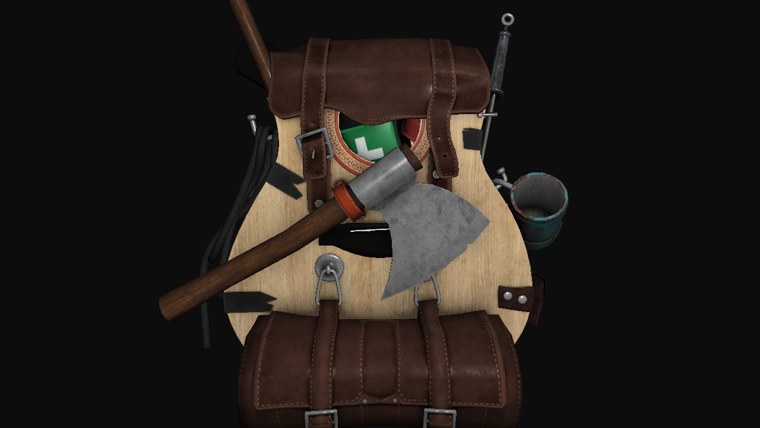
That is a great deal more interesting to look at than a marble cube. Fly around it (WASD, Space and Shift, right mouse button to look) and watch the specular map at work: the metal of the axe head and the buckles catches the light, while the leather and wood stay matte. A model that is moved or scaled would need its normal matrix from transforms.rasm, which does for any vertex buffer what
Our reader handles the subset of .obj that these lessons' models use. Files from the internet will sometimes trip it up: faces with negative (relative) indices, several materials, absolute texture paths, or a format other than .obj altogether. Exporting from Blender with materials written and the path mode set to relative is the quickest way to get a file it reads. The full lesson is here, its shader here, and the loader here.
Additional resources
- Object Files (.obj) and MTL material format: Paul Bourke's copies of the format descriptions, including the parts we skip.
- Wavefront .obj file on Wikipedia: a shorter overview with examples.
- LearnOpenGL's Assimp, Mesh and Model chapters: the library route, with Assimp's scene and node structure.
- Survival Guitar Backpack by Berk Gedik, the model used here.
Exercises
- Count how many vertices a deduplicating loader would produce for the backpack: make a key of each corner's
a/b/ctriple, and count the distinct keys. Compare with the 203,721 vertices loaded now. - Use that count to build an index buffer: give each distinct triple one vertex, write a
u32index per corner, and draw withDrawIndexed . The picture should not change. - Load the backpack with flip_v, the last argument of
model_load , set to 1 and look at what happens to its textures. Then loadresources/objects/planet/planet.obj(directoryresources/objects/planet/) both ways and decide which one it needs. - Support several materials: note the vertex count at each
usemtlline, keep a range of vertices and a set of textures per material, and draw each range withDraw 's start-vertex argument.